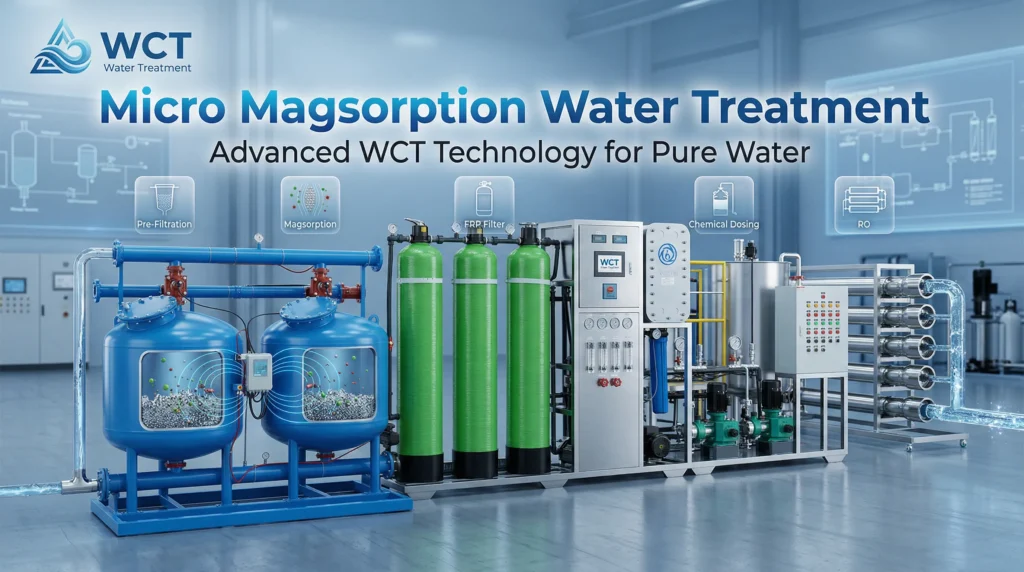
You might already know that hitting strict zero liquid discharge (ZLD) targets is getting harder every year.
Traditional coagulation and filtration systems just aren\’t cutting it for stubborn micropollutants.
But how do you efficiently strip heavy metals and complex organics without massively expanding your facility\’s footprint?
Well, you\’re in for a treat.
In this guide, I\’m breaking down exactly how micro magsorption water treatment solves this massive industrial bottleneck.
You\’ll learn the core mechanisms behind magnetic nanoadsorption, the real-world operational ROI, and exactly how to scale it for your facility.
Let\’s dive right in.
The Core Mechanism of Micro Magsorption Water Treatment
As water treatment professionals, we constantly battle the footprint constraints of massive settling tanks and the high operational costs of traditional solid-liquid separation equipment. Micro magsorption water treatment solves this by combining advanced nanomaterials with high-gradient magnetic forces. This targeted approach offers rapid, precise pollutant removal without the bottleneck of gravity settling. The process operates through three highly engineered phases.
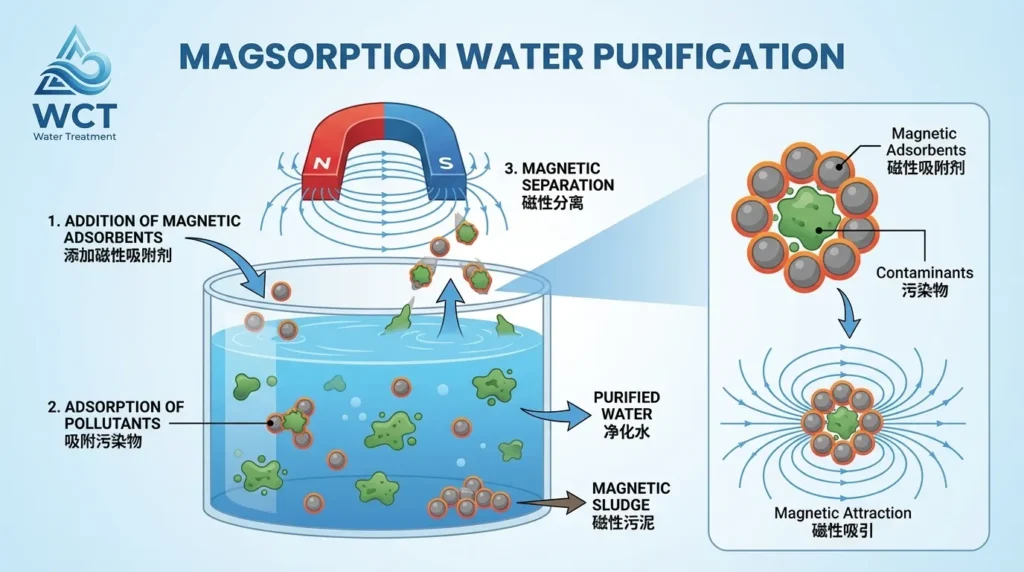
Phase 1: High-Capacity Adsorption
The process begins by introducing highly engineered magnetic nanoparticles into the wastewater stream. Because these micro/nano-particles possess a massive surface area-to-volume ratio, they function as aggressive chemical sponges. During this phase, the particles rapidly bind to and trap a wide range of stubborn contaminants, including:
- Dissolved heavy metals from industrial manufacturing runoff.
- Synthetic dyes and complex organic compounds.
- Trace micropollutants that standard biological or chemical treatments typically leave behind.
Phase 2: Instant Magnetic Separation
Once the target contaminants are locked onto the magnetic cores, we apply a powerful external magnetic field to the treatment stream. This is where micromagsorption water treatment outperforms conventional methods. Instead of relying on gravity and waiting hours in slow settling clarifiers—or burning excessive energy through traditional centrifugation—the magnetic field instantly pulls the pollutant-loaded particles out of the liquid phase. This rapid magnetic solid-phase extraction reduces separation time from hours to mere seconds, instantly yielding clear, purified water.
Phase 3: Magnetic Adsorbent Regeneration
To make this technology economically viable for large-scale B2B applications, the system is designed for continuous reuse. Once separated, the concentrated sludge enters the magnetic adsorbent regeneration phase. Here, specialized desorption agents strip the concentrated heavy metals and organics away from the magnetic cores. The cleaned adsorbent particles are then recycled directly back into the primary treatment feed. This closed-loop recovery significantly lowers long-term material costs, generates highly concentrated waste for easier downstream handling, and aligns with the goals of modern zero liquid discharge (ZLD) systems.
Core Materials in Micro Magsorption Water Treatment
To make our micro magsorption water treatment systems highly efficient, we rely on specifically engineered materials. The effectiveness of this process comes down to two main components: a highly responsive magnetic core and a targeted outer protective shell.
Magnetite Water Treatment Cores
The engine of our nanomagnet adsorbents is the core material itself. We primarily use iron oxides—specifically magnetite and maghemite—as the foundation.
- Highly Responsive: They react instantly to external magnetic fields, allowing for rapid solid-liquid separation.
- Cost-Effective: These standard iron oxides are affordable to produce, making them highly practical for large-scale industrial water treatment operations.
- Reliable Foundation: They provide a solid, dense core that easily pulls attached pollutants out of the water column.
Surface Modification of Magnetic Nanoparticles
Bare iron oxide cores can sometimes degrade when exposed to harsh, corrosive wastewater. To prevent this breakdown and to actively target specific pollutants, we apply precise surface modifications to the magnetic nanoparticles in water treatment applications.
By coating the magnetic cores, we can customize the adsorbent to handle different types of wastewater streams:
- Polymer Coatings: Excellent for trapping specific dyes and complex organic compounds.
- Carbon Shells: Increases the overall surface area, making it highly effective for capturing heavy metals and stubborn chemical runoffs.
- Silica Layers: Acts as a heavy-duty shield, protecting the magnetic core from highly acidic or alkaline environments.
These custom outer layers allow our micromagsorption water treatment technology to selectively lock onto unwanted contaminants while surviving harsh chemical environments, ensuring the materials can be effectively regenerated and reused over the long term.
Micro Magsorption Water Treatment vs. Traditional Methods
When we upgrade a facility to use micro magsorption water treatment, the performance leap over traditional clarifiers is immediate. By moving away from slow, gravity-based separation, we solve some of the biggest bottlenecks in industrial wastewater management.
Here is exactly how micromagsorption water treatment outperforms conventional systems:
- Smaller Footprint: Traditional dissolved air flotation (DAF) tanks require massive amounts of real estate. Magnetic separation needs a fraction of that space. This compact design is ideal for facilities looking to upgrade without expanding, and it pairs seamlessly with modern integrated sewage treatment equipment to maximize your plant\’s layout.
- Lower Chemical Usage: We drastically reduce—and in some cases, completely eliminate—the need for standard bulk coagulants (PAC/PAM) and chemical flocculants.
- Rapid Processing Time: Waiting for gravity settling takes hours. By applying targeted magnetic fields, this advanced solid-liquid separation equipment pulls pollutants out of the water in minutes or even seconds. This speed completely streamlines the standard water treatment plant process flow.
- Reduced Sludge Volume: Instead of generating massive amounts of watery waste, magnetic flocculation produces a highly concentrated sludge. This significantly eases the burden on your downstream sludge dewatering systems and immediately cuts disposal costs.
Industrial Applications of Micro Magsorption
When dealing with complex contamination, micro magsorption water treatment steps up where standard methods fail. We supply advanced solid-liquid separation equipment that adapts to the toughest environments, driving industrial wastewater remediation across multiple high-demand sectors:
- Oil & Gas: Produced water is often loaded with stubborn emulsified oils and complex hydrocarbons. Magnetic adsorbents rapidly isolate and extract these organics directly from the water cycle.
- Automotive & Manufacturing: Factory runoff frequently contains a mix of paints, solvents, and dissolved metals. Magsorption is highly effective for heavy metal removal wastewater processing, capturing toxic elements right at the assembly line.
- Aerospace & Defense: Defense and aerospace manufacturing creates highly specific, toxic chemical runoffs. This technology handles those hazardous streams with absolute precision and reliability.
- Municipal & Domestic: Upgrading city infrastructure is critical for the * Oil & Gas: Produced water is often loaded with stubborn emulsified oils and complex hydrocarbons. Magnetic adsorbents rapidly isolate and extract these organics directly from the water cycle.
- Automotive & Manufacturing: Factory runoff frequently contains a mix of paints, solvents, and dissolved metals. Magsorption is highly effective for heavy metal removal wastewater processing, capturing toxic elements right at the assembly line.
- Aerospace & Defense: Defense and aerospace manufacturing creates highly specific, toxic chemical runoffs. This technology handles those hazardous streams with absolute precision and reliability.
- Municipal & Domestic: Upgrading city infrastructure is critical for the future. Integrating micromagsorption water treatment into the standard process flow diagram of a water treatment plant.
- Oil & Gas: Produced water is often loaded with stubborn emulsified oils and complex hydrocarbons. Magnetic adsorbents rapidly isolate and extract these organics directly from the water cycle.
- Automotive & Manufacturing: Factory runoff frequently contains a mix of paints, solvents, and dissolved metals. Magsorption is highly effective for heavy metal removal wastewater processing, capturing toxic elements right at the assembly line.
- Aerospace & Defense: Defense and aerospace manufacturing creates highly specific, toxic chemical runoffs. This technology handles those hazardous streams with absolute precision and reliability.
- Municipal & Domestic: Upgrading city infrastructure is critical for the future. Integrating micromagsorption water treatment into the standard process flow diagram of a water treatment plant provides a highly efficient method for removing pharmaceutical residues, microplastics, and other difficult micropollutants from the public water supply.
Challenges in Micro Magsorption Water Treatment
While micro magsorption water treatment delivers incredible results for micropollutant removal, shifting from a pilot project to a full-scale plant comes with specific hurdles. We see three main challenges that industries must overcome to adopt this technology fully.
- High Synthesis Costs: Producing high-performance nanomagnet adsorbents often involves complex manufacturing, such as co-precipitation synthesis. This makes the upfront material cost noticeably higher than relying on cheap, traditional bulk chemicals. Even with the long-term financial benefits of magnetic adsorbent regeneration, the initial capital expenditure can be a barrier for standard industrial wastewater remediation projects.
- Large-Scale Hydraulics: Maintaining a powerful, uniform magnetic field in high-capacity setups (processing 1000+ GPD) is a major engineering test. You need highly specialized solid-liquid separation equipment that maintains efficiency across massive volumes. To manage these heavy flows and ensure the magnetic field functions perfectly, we integrate these systems with a robust, custom-engineered waste water treatment tank to stabilize fluid dynamics.
- Secondary Pollution Risks: Facility operators must guarantee that magnetic nanoparticles in water treatment do not escape the magnetic capture zone. If these particles bypass the separation phase and enter the local ecosystem, it completely undermines the goal of eco-friendly water purification. Building in precise mechanical fail-safes to achieve 100% particle retention is an absolute requirement for any safe micromagsorption water treatment facility.
How WCT Supports Micro Magsorption Water Treatment Integrations
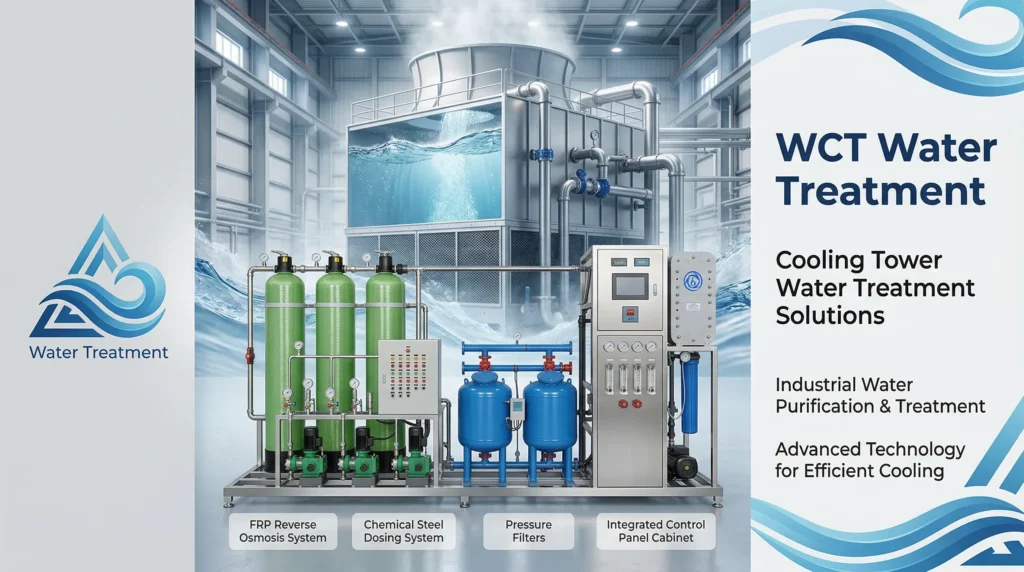
As a dedicated water treatment products supplier and manufacturer, we know that deploying new technology requires robust and adaptable hardware. With 12 years of hands-on manufacturing experience, 30 active patents, and a specialized team of 20+ R&D engineers, we custom-build reliable systems ready for advanced industrial wastewater remediation.
Seamless System Compatibility
Integrating micro magsorption water treatment into an active facility demands precision. A deep understanding of how water treatment plants work at scale drives our engineering process. We design our core hardware to perfectly support high-tech magnetic extraction concepts:
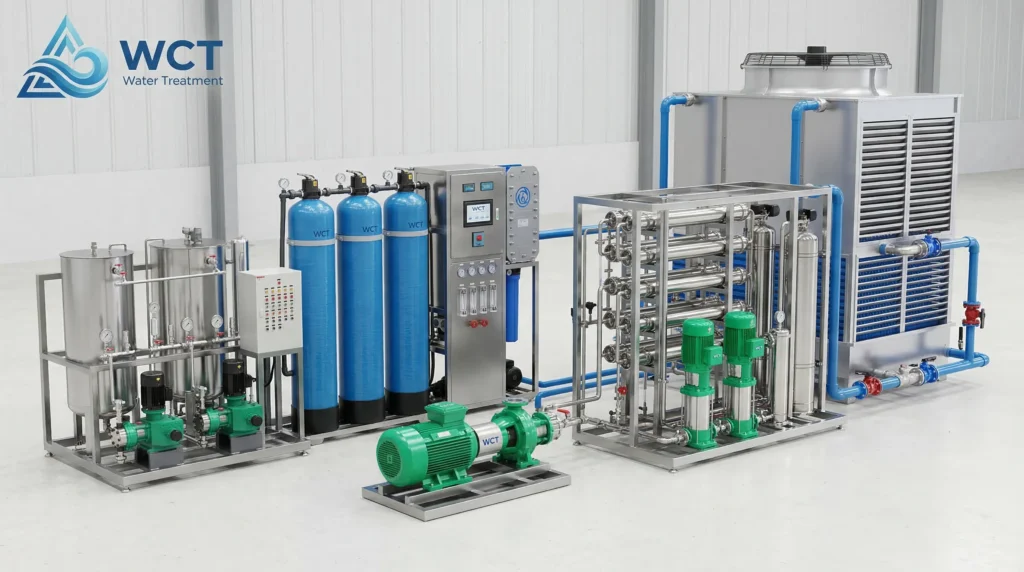
- PE304 Stainless Steel Tanks: Highly durable reactors engineered to handle the physical demands of continuous magnetic adsorbent regeneration.
- CDLF+CDH High-Pressure Pumps: Delivering the stable, heavy-duty flow rates required to keep fluids moving smoothly through the magnetic zones.
- Precision Filters: Acting as a reliable final polish alongside your primary solid-liquid separation equipment to catch any residual micro-particles.
ISO9001 Certified Reliability
Upgrading to zero liquid discharge (ZLD) systems or implementing advanced magnetic separation means equipment failure is simply not an option. Our entire manufacturing process operates under strict ISO9001 certification. This provides plant managers with the ultimate quality assurance—guaranteeing that every tank, pump, and filter we produce delivers absolute safety and long-term mechanical reliability for your operations.