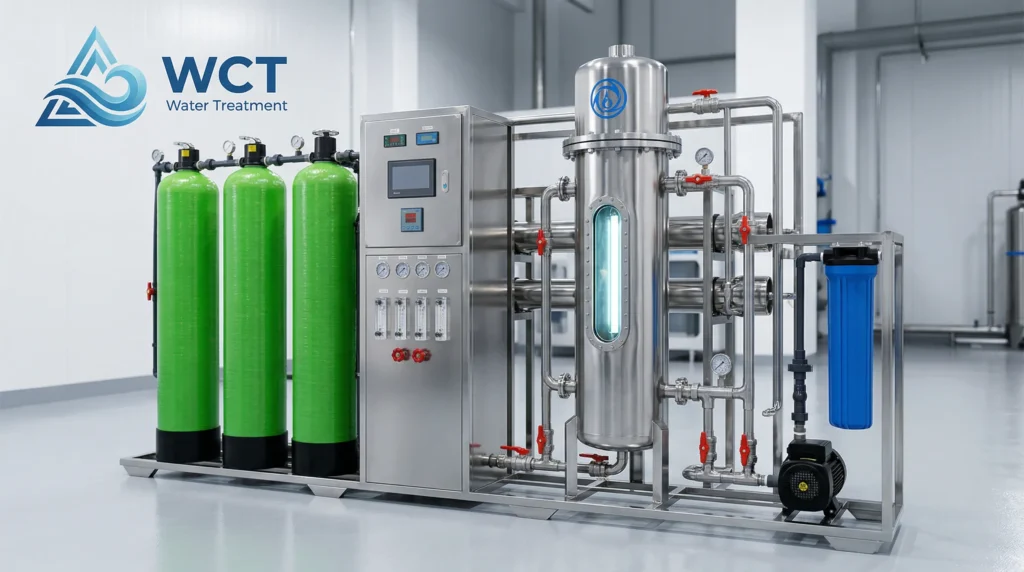
Are you struggling to choose the right commercial UV water treatment system for your facility?
Selecting the perfect industrial water purification setup can make a massive difference in your operational efficiency, safety, and bottom line.
As an industry professional, I know that investing in reliable commercial UV sterilization is crucial. I\’m going to give you guidance that goes way beyond the basics of ultraviolet disinfection.
You might already know that commercial ultraviolet water systems provide highly effective, chemical-free water treatment.
But how do you accurately size your GPM flow rates? Or choose between UV disinfection vs. reverse osmosis?
In this post, you\’re going to learn exactly how to select, implement, and maintain the perfect high flow commercial UV systems for your specific needs.
Let\’s dive right in!
Key Benefits of Commercial UV Sterilization
As a dedicated water treatment products supplier and manufacturer, we know that modern industries demand secure, efficient, and scalable solutions. Implementing a commercial UV water treatment system provides the ultimate safeguard for your water supply, ensuring continuous purification without compromising operational efficiency.
Eco-Friendly and Chemical-Free Water Treatment
Traditional water disinfection relies heavily on harsh chemicals like chlorine, which can alter water chemistry and leave unwanted odors. Our commercial UV water treatment technology eliminates this reliance entirely. By utilizing specialized ultraviolet light, the purification process introduces no chemicals into the water. This guarantees zero harmful by-products, protecting the environment while maintaining the water\’s natural taste and original composition.
High Effectiveness Against Bacteria and Viruses
UV sterilization delivers unparalleled biological protection. When water flows through the chamber, intense UV-C light instantly penetrates the cell walls of microorganisms, disrupting their DNA and preventing reproduction.
| Target Pathogen | Neutralization Rate | Chemical Required |
|---|---|---|
| Bacteria (e.g., E. coli, Salmonella) | 99.99% | None |
| Viruses (e.g., Hepatitis, Norovirus) | 99.99% | None |
| Protozoan Cysts (e.g., Giardia) | 99.99% | None |
Cost-Efficiency and Minimal Water Waste
Investing in commercial UV water treatment delivers immediate and long-term financial returns. Unlike complex reverse osmosis or media filtration systems that require extensive backwashing, UV disinfection operates with zero water discharge.
- Low Operating Costs: The system consumes minimal electricity, comparable to a standard light bulb.
- Zero Water Loss: 100% of the water passing through the system is purified and ready for immediate use.
- Minimal Maintenance: Designed for continuous operation, requiring only simple, annual UV lamp and quartz sleeve replacements to maximize uptime.
Types of Commercial Ultraviolet Water Systems
When you run a large-scale operation, you need a commercial UV water treatment system that fits your exact demand. As an experienced water treatment products supplier and manufacturer, we engineer our systems to handle varying capacities, harsh water conditions, and strict regulatory standards.
High Flow Commercial UV Systems
Standard filters simply cannot keep up with industrial processing. We build high flow units specifically for heavy-duty commercial UV water treatment.
- Maximum Capacity: Easily processes hundreds of gallons per minute (GPM) for large facilities.
- Zero Downtime: Engineered for continuous 24/7 operation without causing significant pressure drops.
- Multi-Lamp Design: Ensures complete and consistent UV exposure, even at peak water velocities.
NSF and EPA Validated UV Filters
Regulatory compliance is non-negotiable for public safety and business operations. Our validated systems provide documented, undeniable proof of performance.
- NSF Class A Certified: Guarantees the precise UV dosage required for safe, potable drinking water.
- EPA Compliant: Meets strict federal and local health guidelines for commercial water systems.
- Auditable Safety: Delivers reliable, consistent disinfection data that you can hand straight to health inspectors.
Integrated UV Systems with Pre-Filtration
UV light needs clear water to work properly. Suspended particles and cloudy water block the UV rays, creating shadows where bacteria can hide. That is why we directly integrate heavy-duty pre-filtration with our UV units. By pairing our commercial UV reactors with a reliable well water treatment system or sediment filter, we eliminate turbidity before the sterilization stage. This guarantees optimal water clarity and maximum UV efficiency.
Common Industrial and Commercial UV Applications
As a global water treatment products supplier and manufacturer, we know that a reliable commercial UV water treatment system does heavy lifting across multiple industries. It is not just about killing germs; it is about solving complex water quality problems without adding harsh chemicals.
Food, Beverage, and Light Commercial Uses
In the food and beverage sector, water purity directly impacts your product\’s taste and safety. Integrating a commercial UV water treatment setup guarantees clean water for recipes, rinsing, and bottling.
- Breweries & Bottling Plants: Protects flavor profiles by keeping process water completely chemical-free.
- Restaurants & Hospitality: Ensures ice machines and drinking water lines stay compliant and safe.
- Light Industrial Systems: Maintains clean process water. Similar to how proper cooling tower water treatment prevents biological growth and maintains system efficiency, UV keeps production lines clean and running smoothly.
Chlorine, Chloramine, and Ozone Reduction
UV technology is highly effective at chemical destruction. Facilities rely on strong UV light to strip leftover chemicals from their water lines to protect sensitive downstream equipment.
- Chlorine & Chloramine Breakdown: High-intensity UV light breaks the chemical bonds of free chlorine and chloramine, protecting expensive reverse osmosis (RO) membranes from oxidation damage.
- Ozone Destruction: Instantly converts residual ozone back into standard, safe oxygen before the water reaches its final point of use.
Total Organic Carbon (TOC) Reduction
High-tech sectors, like pharmaceuticals and microelectronics, demand ultrapure water. Specialized UV systems operating at a 185nm wavelength effectively destroy organic molecules to meet strict global standards.
- TOC Destruction: Breaks complex organic compounds down into harmless byproducts.
- Prevents Fouling: Keeps expensive ultra-fine filters and piping clear of organic buildup.
- Industrial Integration: These UV units work seamlessly within larger, robust setups, often alongside heavy-duty equipment like high-pressure pumps for waste water treatment to handle rigorous industrial demands.
How to Choose the Right Commercial UV System
Finding the exact commercial uv water treatment system for your business does not have to be a headache. As an experienced water treatment products supplier and manufacturer, we focus on matching the equipment directly to your site\’s operational needs.
Sizing Your System: GPM Flow Rates Explained
Size dictates performance. If water moves too fast, the UV light cannot neutralize pathogens effectively. You must match the unit to your peak flow rate.
- Calculate Peak Demand: Find your absolute maximum Gallons Per Minute (GPM) during your busiest operating hours.
- Ensure Proper Exposure: The correct GPM rating guarantees the water receives a lethal UV dose.
- Match Plumbing: Verify the unit\’s inlet and outlet ports align with your current pipes to prevent pressure drops.
Comparing UV Disinfection vs. Reverse Osmosis (RO)
While both are essential for reliable commercial uv water treatment, they perform entirely different jobs. We often combine them in complete water plant treatment configurations for maximum purity.
| Feature | UV Disinfection | Reverse Osmosis (RO) |
|---|---|---|
| Main Target | Bacteria, viruses, pathogens | Dissolved solids, heavy metals |
| Water Waste | Zero waste | Produces concentrate (wastewater) |
| Maintenance | Annual lamp replacements | Filter and membrane swaps |
| Energy Usage | Low | High (requires high-pressure pumps) |
Stainless Steel Construction and Equipment Standards
Industrial environments demand rugged materials. We build our UV reactor chambers using heavy-duty 304 or 316L stainless steel. This guarantees high-pressure tolerance and superior resistance to corrosion. When you pair a tough stainless steel UV reactor with professional water treatment tanks, you secure an industrial-grade defense system that effortlessly meets strict NSF and EPA safety standards.
Maintaining Your Industrial UV Water Filter
As we are a water treatment products supplier and manufacturer, we know firsthand that installing a commercial UV water treatment system is only half the job. Proper upkeep is what guarantees long-term performance and safe water. Maintaining these systems is straightforward if you stick to a regular schedule.
Routine Maintenance and Cleaning Requirements
Minerals and debris in your water will eventually coat the quartz sleeve inside the UV chamber. When this sleeve gets cloudy, the UV light can\’t pass through to sterilize the water. Depending on your water quality, you might also be running parallel setups, such as boiler water treatment systems, to manage heavy scaling across your facility.
To keep your commercial UV water treatment running at peak efficiency:
- Inspect monthly: Check the quartz sleeve for any fouling or cloudiness.
- Clean the sleeve: Wipe it down with a mild acid or specialized cleaner to remove mineral scale.
- Check seals: Inspect the O-rings during cleaning and replace them if they show wear to prevent leaks.
When and How to Replace the UV Lamp
A common mistake is assuming the lamp is working just because it is glowing. Over time, the intensity of the UV-C light drops. You need to replace components on a strict schedule to ensure maximum disinfection.
| Component | Lifespan | Action Required |
|---|---|---|
| UV Lamp | 9,000 to 12,000 hours (approx. 1 year) | Replace to maintain effective UV dosage. |
| Quartz Sleeve | 2 years | Replace if permanently stained, scratched, or cracked. |
Monitoring Energy Usage and System Performance
Keeping an eye on your system\’s metrics prevents unexpected downtime. Modern systems have built-in sensors that do the heavy lifting for you. In many setups, pre-filtering the water with reverse osmosis membranes helps keep the water clear, ensuring the UV light works effectively without wasting energy.
Pay attention to these core indicators:
- UV Intensity Monitors: These track the actual light output and trigger an alarm if it drops below safe levels.
- Flow Rate Sensors: Ensure the water isn\’t moving too fast; excessive speed reduces the exposure time needed for sterilization.
- Power Ballast Indicators: Check the control panel regularly to confirm steady power delivery and catch electrical faults early.