You might already understand the basics of filtration, but do you know how to optimize the entire process of water treatment for maximum industrial efficiency?
Designing a system that meets strict effluent standards while keeping operational costs low is a complex engineering challenge. Whether you are managing seawater desalination or treating industrial wastewater, the specific hardware you deploy at each stage matters.
In this guide, we are going to break down the treatment lifecycle step-by-step—from preliminary chemical dosing and Dissolved Air Flotation (DAF) to advanced Reverse Osmosis (RO). You will learn exactly how to map these stages to the right equipment to turn raw intake into compliant, clean water.
Let’s dive into the engineering details.
Preliminary Screening and Chemical Dosing
Coagulation in the Process of Water Treatment
Every efficient process of water treatment begins with tackling raw water turbidity. At a microscopic level, untreated water is packed with colloidal particles carrying negative electrical charges. Because these particles constantly repel each other, the suspended solids refuse to settle out naturally.
To solve this, our systems utilize precision PAC/PAM dosing. By introducing these highly effective coagulants, we neutralize the negative charges on the colloidal particles. This critical treatment process of water forces the destabilized particles to collide and bind together, preparing them for physical removal.
Automatic Chemical Dosing Systems
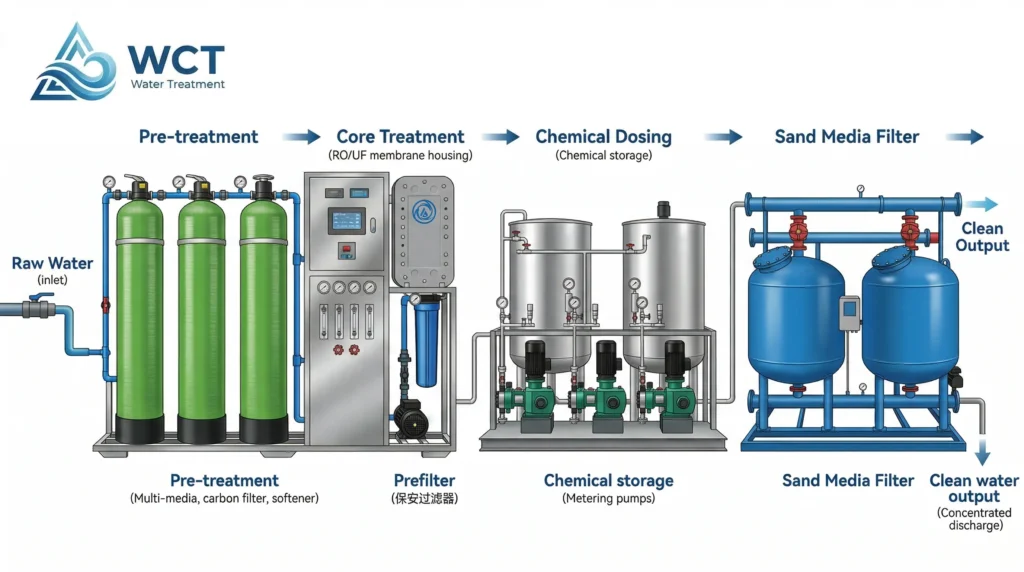
Getting the chemical balance exactly right is non-negotiable for a reliable process for water treatment. We eliminate guesswork by deploying industrial-grade Automatic Chemical Dosing Systems designed for continuous, high-efficiency operation.
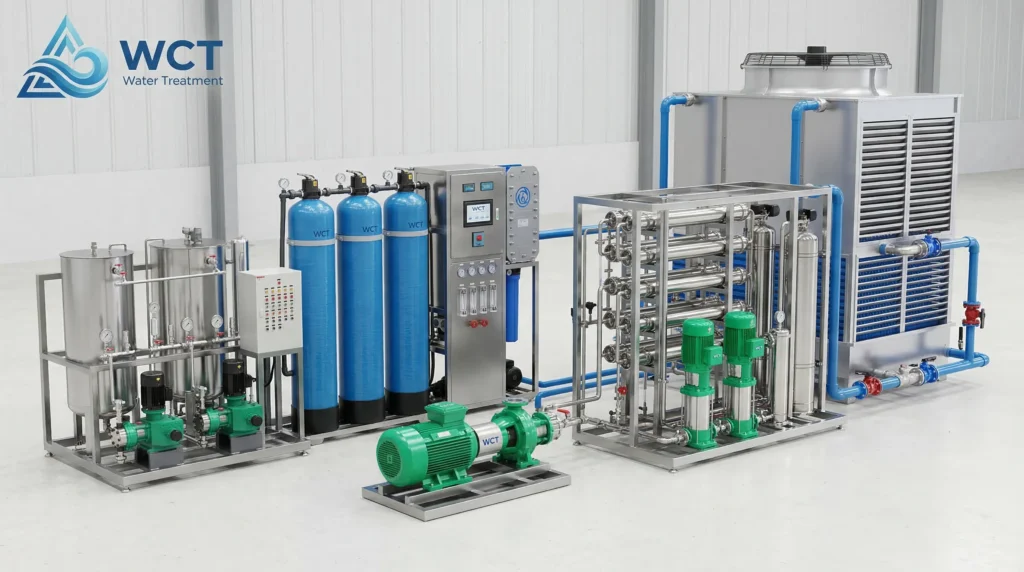
- PE304 Stainless Steel Dosing Tanks: Built to endure. We construct our tanks using PE304 stainless steel to guarantee maximum corrosion resistance, ensuring a secure and long operational lifespan even when handling highly aggressive chemical coagulants.
- AXB Series Mechanical Diaphragm Metering Pumps: Precision drives our engineering. A successful process in water treatment requires absolute accuracy. Our AXB Series chemical dosing pumps deliver exact, consistent chemical volumes—preventing costly under-dosing or chemical waste while optimizing the entire process of treatment of water.
Flocculation and Solid-Liquid Separation
After neutralizing the charges on colloidal particles, the next critical phase in the process of water treatment is flocculation. We introduce specific polymers to bind these destabilized tiny particles into larger, heavier masses known as flocs. Implementing effective flocculant water treatment ensures these clusters grow large and stable enough for the physical separation phase.
Sedimentation vs. Flotation Mechanics
Once the flocs are formed, we must extract them from the clear water. The treatment process of water generally relies on two primary mechanics to achieve this separation: sinking heavy solids or floating light ones.
- Sedimentation for Heavy Flocs: For dense, heavy solids, we utilize radial or horizontal flow sedimentation tanks. Gravity pulls the suspended solids to the bottom of the tank, allowing clear water to flow out from the top.
- Dissolved Air Flotation (DAF) for Light Solids: Oils, grease, and low-density particles simply won\’t sink. To remove them, we use Dissolved Air Flotation (DAF) systems. We inject highly pressurized air into the water, creating millions of microscopic bubbles. These bubbles attach to the lightweight flocs, rapidly lifting them to the surface where mechanical skimmers scrape them away.
High-Efficiency Separation Benefits
Optimizing this solid-liquid separation stage is non-negotiable in any reliable process for water treatment. High-efficiency separation guarantees maximum suspended solids removal upfront. This directly prevents fouling in downstream equipment, protects advanced filtration systems, and keeps your facility\’s operational costs under tight control.
Advanced Filtration and Desalination (RO Process)
When we look at the complete process of water treatment, the most critical stage for achieving high purity is advanced filtration and desalination. This is where we strip away impurities down to the molecular level, ensuring the water meets stringent standards for industrial applications or potable water purification.
The Mechanics of Reverse Osmosis
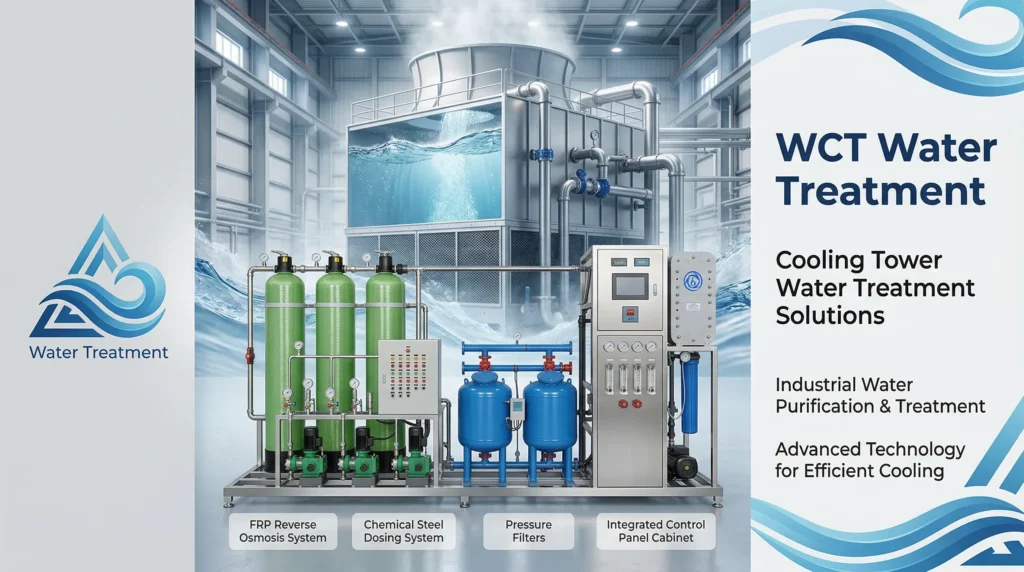
At the core of this stage is our Reverse Osmosis System. Reverse osmosis (RO) works by forcing raw water through a semi-permeable membrane under intense pressure, effectively blocking dissolved salts, heavy metals, and organic contaminants. To prevent scaling and protect these sensitive membranes during the treatment process of water, precise antiscalant chemical injection is mandatory. We rely on highly accurate equipment like the WCT AX Series Mechanical Diaphragm Metering Pump to deliver the exact chemical dosing required, keeping the RO system running at peak efficiency.
High-Capacity RO and Desalination Equipment
Because every facility has different production demands, we design our equipment to handle the exact process in water treatment needed for your site:
- 1000 GPD Capacity RO Systems: Built for mid-to-large scale operations, these units deliver a massive daily output of purified water with minimal downtime.
- Seawater Desalination Plant Integration: For offshore or coastal operations dealing with extreme salinity levels, our desalination setups utilize specialized membranes to separate salt from water efficiently.
- CDLF+CDH High-Pressure Pumps: Pushing water through ultra-fine membranes requires serious power. We utilize high-efficiency CDLF+CDH pumps to maintain the intense, consistent pressure needed for the process for water treatment, lowering overall energy consumption while maximizing your clean water recovery rates.
Getting the RO and desalination stage right is ultimately what defines a successful process of treatment of water, transforming difficult raw water into a highly valuable, usable resource.
Sludge Dewatering in the Process of Water Treatment
A critical stage in any efficient treatment process of water is handling the leftover solids. By actively reducing sludge volume, facilities can drastically lower transportation and disposal costs. The ultimate goal in this phase is straightforward: transforming heavy, liquid waste into a dry, manageable solid cake.
Here is how we handle sludge management effectively:
- Sludge Dewatering Equipment: Our reliable WCT sludge dewatering systems are engineered to squeeze maximum moisture from industrial waste. This ensures optimal suspended solids removal and significantly reduces the overall weight and footprint of the waste.
- Thickening and Dosing: Before the pressing starts, the sludge needs proper conditioning. The role of automated polymer dosing units is vital in the thickening phase. These units accurately inject chemicals to bind particles together, making the liquid-to-solid separation fast and highly effective.
Integrating these steps into the process for water treatment ensures your facility runs smoothly while keeping environmental compliance and operational overhead in check.
Customizing the Process of Water Treatment for Specific Industries
We know that the process in water treatment is never a one-size-fits-all solution. Different sectors demand unique setups. We customize our systems because industrial wastewater treatment requires a much more aggressive approach compared to standard potable water purification.
Domestic vs. Oil & Gas Setups
The differences between these setups are massive. Domestic facilities focus on lowering raw water turbidity and removing basic pathogens. Oil and gas setups face extreme contamination. They must handle heavy hydrocarbons, toxic compounds, and high salinity, routinely relying on custom water treatment skids to meet strict effluent standards.
Aerospace vs. Domestic Safety
Aerospace manufacturing demands ultra-pure water to prevent microscopic defects on critical flight components. We design these high-tech systems to target Zero Liquid Discharge (ZLD) using industrial-grade materials. On the flip side, domestic safety is much more straightforward. A standard well water treatment system effectively secures clean drinking water for residential properties without the need for aerospace-level precision. Similarly, for heavy industrial heating applications, specialized setups for the treatment of boiler water are deployed solely to prevent scaling and long-term corrosion.
Smart Water Solutions and Automation
We integrate smart automation to make the process of treatment of water as hands-off and efficient as possible. Automated sensors continuously monitor the water quality and instantly adjust a mechanical diaphragm metering pump based on real-time data, ensuring exact chemical dosing without any manual guesswork.
Industry Needs at a Glance
| Industry Target | Primary Focus | Key Technology Used |
|---|---|---|
| Domestic Use | Safe drinking water, basic filtration | Well water systems, basic filtration |
| Oil & Gas | Hydrocarbon separation, toxic waste | Dissolved Air Flotation (DAF), Heavy-duty skids |
| Aerospace | Ultra-pure water, zero component defects | Reverse Osmosis System, ZLD tech |
| Industrial Plants | Equipment longevity, scaling prevention | Boiler water treatment, automated dosing pumps |
FAQ: The Process of Water Treatment Explained
What is the difference between coagulation and flocculation?
In the process of water treatment, these two steps work hand-in-hand to clear up raw water turbidity.
- Coagulation: We dose chemical coagulants to neutralize the electrical charges of tiny, suspended particles so they stop repelling one another.
- Flocculation: This is a gentle mixing stage. The neutralized particles collide and bind together into larger, heavier clumps called \”flocs,\” which are then easy to filter or settle out.
How does Dissolved Air Flotation (DAF) work?
A Dissolved Air Flotation (DAF) setup is perfect for removing light contaminants that refuse to sink. The system injects highly pressurized, microscopic air bubbles into the water. These tiny bubbles attach directly to suspended solids, oils, and greases, rapidly floating them to the surface. Once at the top, a mechanical skimmer simply scrapes the sludge layer away.
Why is sludge dewatering necessary?
The sludge generated during industrial wastewater treatment is primarily liquid. If you skip dewatering, you end up paying a massive premium to transport and dispose of heavy water weight. Sludge dewatering equipment mechanically squeezes the water out, transforming liquid waste into a compact, manageable solid cake. This cuts your disposal costs down to a fraction and is a critical step for plants aiming for Zero Liquid Discharge (ZLD).
What are the main stages of Reverse Osmosis?
A commercial Reverse Osmosis System purifies water at a molecular level. The standard process involves four main stages:
- Pre-filtration: Media filters remove large suspended solids, organics, and chlorine to prevent membrane fouling.
- Pressurization: High-pressure pumps force the pre-treated feed water directly against the RO membrane.
- Membrane Separation: The semi-permeable membrane acts as a barrier. It allows only pure water molecules to pass through while rejecting dissolved salts, heavy metals, and micro-pollutants.
- Post-treatment: A final stage of UV sterilization or remineralization guarantees the output meets exact potable water purification or industrial standards.