Understanding Distilled Water and pH Basics
What is Distilled Water?
Distilled water is a highly purified liquid created through a meticulous boiling and condensation process. When source water is heated to its boiling point, it turns into vapor, leaving behind dissolved minerals, heavy metals, chemicals, and other impurities. This vapor is then captured, cooled, and condensed back into liquid form to create pure distilled water. As a dedicated water treatment products supplier and manufacturer, we utilize advanced distillation technology to ensure the final product is entirely stripped of contaminants. This rigorous purification makes distilled water the gold standard for laboratory, medical, and industrial applications where absolute purity is required.
How the pH Scale Works
To fully grasp water chemistry, it is essential to understand the pH scale. This universal measurement system evaluates the concentration of hydrogen ions in a liquid, determining whether a substance is acidic, neutral, or alkaline.
The scale ranges from 0 to 14 and operates on a logarithmic curve, meaning each whole number represents a tenfold change in acidity or alkalinity:
- 0 to 6.9 (Acidic): Liquids falling in this range have an acidic pH. Common examples include vinegar, lemon juice, and black coffee.
- 7.0 (Neutral): A reading of exactly 7.0 represents a perfectly neutral pH. This is the theoretical baseline for completely pure water isolated from environmental factors.
- 7.1 to 14 (Alkaline/Basic): Liquids in this upper range are alkaline. Examples include baking soda, ammonia, and liquid bleach.
Grasping the mechanics of this scale is the first critical step in evaluating water quality and understanding exactly what\’s the pH of distilled water under real-world conditions.
What is the Exact pH of Distilled Water?
The Theoretical pH of Pure Water
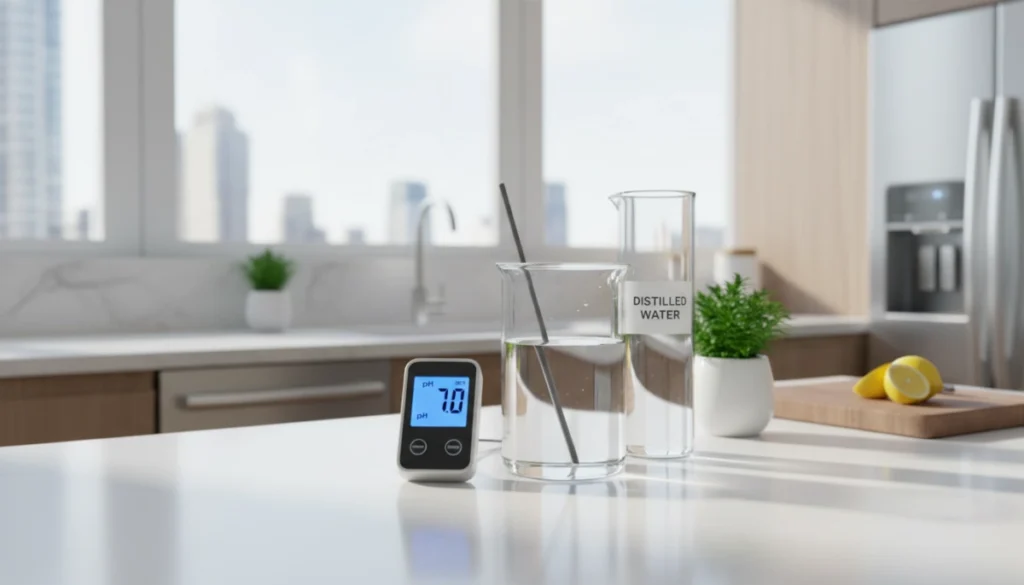
In a perfect laboratory environment, pure distilled water has a neutral pH of 7.0. This represents the exact balance on the pH scale, meaning the water is neither acidic nor basic. When we use distillation to strip away minerals, salts, and organic contaminants, the resulting H2O is theoretically neutral. This baseline is critical for scientific applications where even a slight deviation can alter chemical reactions. Understanding the water treatment process diagram illustrates how we isolate these water molecules to achieve such high purity levels before environmental exposure occurs.
The Actual pH Level in Reality
In practical, everyday conditions, the pH of distilled water is almost never a perfect 7.0. As soon as the water leaves the still and encounters the air, its chemistry begins to shift.
- Real-world pH range: Typically between 5.5 and 6.9.
- Chemical status: Slightly acidic.
- Sensitivity: Because distilled water is \”hungry\” and lacks dissolved minerals to act as a buffer, it is extremely sensitive to its environment.
If you use a calibrated pH meter to test a fresh gallon of distilled water, you will likely see a reading in the 5.8 to 6.2 range. While this makes the water technically acidic, it is a very weak acidity that is standard for high-purity water exposed to the atmosphere.
Why Does Distilled Water Become Acidic?
As a water treatment products supplier and manufacturer, we frequently get asked why pure distilled water rarely stays at a perfect 7.0 on the pH scale. While it leaves the distillation process completely neutral, several environmental factors quickly pull it into an acidic pH range.
Carbon Dioxide Absorption from the Air
The primary reason distilled water becomes acidic is carbon dioxide absorption. The moment pure water is exposed to the atmosphere, it acts like a sponge for CO2. This gas dissolves into the water to form weak carbonic acid. Within just a couple of hours of air exposure, the pH of distilled water will naturally drop from a neutral pH of 7.0 down to around 5.8. In industrial setups, such as those utilizing a commercial UV water treatment system to maintain pristine water quality, keeping the water in sealed, airtight environments post-treatment is critical to preventing this rapid acidification.
The Effect of Temperature on pH
Temperature plays a significant role in how a pH meter reads your water. As the temperature of water rises, the neutral point on the pH scale actually drops.
- At 25°C (77°F): The neutral point is exactly 7.0.
- At 100°C (212°F): The neutral point drops to about 6.14.
This shift happens because heat increases the dissociation of water molecules. The water isn\’t necessarily becoming more \”acidic\” in a harmful way, but the physical reading on your testing equipment will change. Always test your water at room temperature for the most accurate results.
Impact of Storage Containers
Pure distilled water is highly reactive because it has been stripped of all its minerals. It essentially \”wants\” to absorb ions from its surroundings to reach a state of equilibrium.
- Plastic Containers: Standard plastic bottles can leach trace amounts of chemicals and plasticizers into the water over time, subtly lowering the pH.
- Glass Bottles: While generally safer and more stable, even lower-quality glass can release trace silicates into ultra-pure water.
- Air-Tight Seals: Regardless of the material, if the cap isn\’t perfectly airtight, the water will continue to absorb ambient gases.
To maintain the closest thing to a neutral pH, pure distilled water must be stored in high-quality, perfectly sealed glass or specialized high-density polyethylene (HDPE) containers immediately after production.

How to Accurately Measure the pH of Distilled Water
Measuring the pH of distilled water is notoriously difficult because it lacks the ions needed for a stable reading. Standard testing methods often fail or provide erratic results because the water is too pure to conduct an electrical signal effectively. To get a reliable reading, you need to use specific tools and techniques designed for low-conductivity liquids.
Using a Specialist pH Meter
A standard pH meter often struggles with distilled water, leading to \”drifting\” numbers that never settle. To get an accurate result, use a high-quality meter equipped with a low ionic strength (LIS) electrode. These specialized sensors are designed to function in high-purity environments where minerals are absent. Always ensure the meter is calibrated using fresh buffer solutions before testing to maintain precision.
Using pH Indicator Test Strips
For a quick and affordable estimate, pH indicator test strips are a common choice. However, standard litmus paper is often insensitive to the subtle shifts in distilled water. If you use this method, choose high-sensitivity strips with a narrow range (such as pH 5.0 to 8.0). Keep in mind that these strips can be influenced by the very dyes they contain, so they are better for a general \”ballpark\” figure rather than laboratory-grade accuracy.
The Pinch of Salt Testing Method
If you are using a standard pH meter and the reading won\’t stabilize, the \”pinch of salt\” method is a reliable workaround. By adding a tiny amount of high-purity neutral salt, such as potassium chloride (KCl), you increase the ionic conductivity of the water without changing its actual pH level.
- Step 1: Pour a small sample of distilled water into a clean glass.
- Step 2: Add a very small amount of neutral KCl.
- Step 3: Stir gently until dissolved.
- Step 4: Immerse the electrode and wait for a stable reading.
This technique allows the sensor to \”see\” the hydrogen ions more clearly, providing a much more consistent measurement of the pure distilled water sample. Understanding these measurement nuances is as critical to quality control as knowing how do water treatment plants work to produce high-purity water in the first place.
Distilled Water vs. Tap Water pH
When comparing water sources, the most striking difference is the stability of the pH level. While we often discuss what\’s the ph of distilled water in terms of its tendency to turn slightly acidic, tap water is a completely different story due to its mineral content.
Typical pH Levels of Tap Water
Tap water is rarely a neutral 7.0. Depending on your local municipality and the source of the water (groundwater vs. surface water), the pH typically ranges from 6.5 to 8.5. Most city water is intentionally kept slightly alkaline to prevent the corrosion of metal pipes.
| Water Type | Typical pH Range | Primary Influence |
|---|---|---|
| Distilled Water | 5.5 – 7.0 | Carbon dioxide absorption |
| Tap Water | 6.5 – 8.5 | Minerals (Calcium, Magnesium) |
| Reverse Osmosis | 5.0 – 7.0 | Removal of buffering minerals |
Key Differences and Influencing Factors
The main reason tap water maintains a more stable pH than pure distilled water is the presence of \”buffers.\” These are minerals like calcium carbonate that resist rapid changes in acidity. In contrast, distilled water lacks these minerals, making its pH highly volatile.
- Mineral Content: Tap water contains dissolved solids that keep the pH higher. To achieve high-purity water for industrial use, many facilities rely on a WCT ULP series RO membrane to strip these minerals away before further distillation.
- Chemical Treatment: Municipalities add chlorine or fluoride, which can subtly shift the pH scale.
- Environmental Exposure: Once distilled water is exposed to air, it lacks the \”protection\” of minerals, causing it to drop in pH much faster than tap water would under the same conditions.
As a water treatment products supplier, I see firsthand how these differences impact everything from laboratory experiments to household plumbing. While tap water is designed for stability and consumption, distilled water is designed for purity, even if that means dealing with a more sensitive acidic pH.
Common Applications of Distilled Water
Distilled water is more than just a science experiment; its lack of minerals and impurities makes it essential for various high-precision tasks. Because it starts with a neutral pH and contains no dissolved solids, it won\’t interfere with chemical reactions or leave behind stubborn residue.
Medical and Laboratory Uses
In clinical environments, the purity of water is non-negotiable. We use distilled water for cleaning surgical instruments and preparing solutions where even a tiny mineral imbalance could ruin a test result. It is the primary choice for:
- Sterilizing equipment: Prevents scale buildup in autoclaves.
- Reagent preparation: Ensures chemical consistency in lab experiments.
- Wound cleansing: Provides a contaminant-free medium for medical hygiene.
For facilities managing their own purification, reviewing a water treatment plant diagram is helpful for understanding how to integrate high-purity water systems into a professional workflow.
Household Appliances (Humidifiers and CPAP)
Using tap water in sensitive home electronics often leads to \”white dust\” or calcification. Pure distilled water is the recommended choice for CPAP machines and humidifiers because it prevents mineral deposits from clogging the machinery or being dispersed into the air you breathe. It also extends the life of steam irons and facial steamers by keeping the heating elements free from scale.
Automotive and Battery Maintenance
The longevity of a lead-acid battery depends heavily on the quality of the water used to top it off. Tap water contains minerals that can cause internal corrosion or short circuits. Distilled water ensures the chemical balance remains stable. As a water treatment products supplier and manufacturer, we also recommend it for engine cooling systems to prevent rust and blockages in the radiator.
- Battery longevity: Prevents mineral-induced discharge.
- Cooling efficiency: Stops scale from forming in the engine block.
- Cleaning: Ideal for streak-free rinsing of sensitive automotive finishes.
Is it Safe to Drink Distilled Water?
Drinking distilled water is generally safe for short-term use, but it is not the ideal choice for long-term daily hydration. While the distillation process removes contaminants, it also strips away the essential elements our bodies typically get from water.
Health Implications of Slightly Acidic Water
The pH of distilled water often drops below 7.0 due to carbon dioxide absorption, making it slightly acidic. For most healthy individuals, drinking water with a mildly acidic pH is not harmful because the body naturally regulates its own pH balance. However, consistent consumption of acidic beverages can have a minor impact on tooth enamel over time. If you are using distilled water as part of a larger purification setup, integrating a precision filter for water treatment can help ensure the water is free of particulates before any further mineralization or pH adjustment occurs.
The Impact of Missing Minerals
The primary concern with drinking distilled water isn\’t the pH level, but the lack of minerals. Pure distilled water is \”hungry\” water; it contains zero calcium, magnesium, or potassium.
- Mineral Deficiency: Long-term consumption may lead to a lower intake of essential electrolytes.
- Taste Profile: Most people find distilled water tastes \”flat\” or \”dead\” because it lacks the mineral salts found in spring or tap water.
- Leaching Effect: Because it is so pure, distilled water can occasionally leach small amounts of minerals from the body or the containers it is stored in.
- Cooking: Using distilled water for cooking can cause minerals to leach out of your vegetables and into the boiling water, reducing the nutritional value of your meal.
For those who prefer the purity of distilled water but want the health benefits of minerals, many choose to add mineral drops or use a remineralization filter to bring the water back to a more balanced, alkaline state.