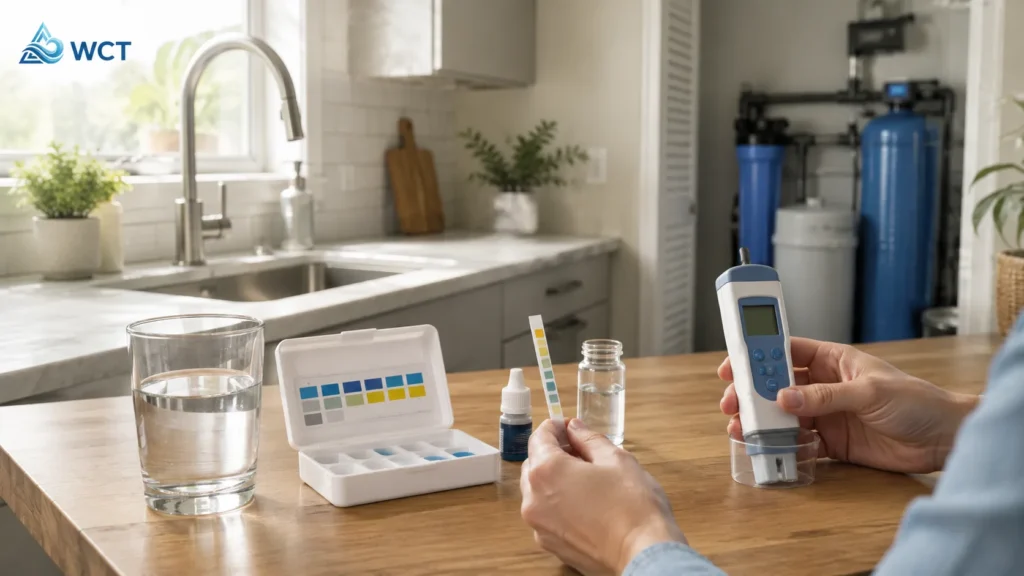
The right water hardness test kit matches your required accuracy, not the price tag. A quick home check for hard water problems needs a strip; softener calibration demands a titration reading. Decide first whether being off by 20% matters—then choose accordingly.
Accuracy Tiers: Which Kit Type Fits Your Goal?
Hardness test kits fall into three distinct accuracy tiers. The break between “good enough” and “wrong tool” often sits at the 1‑grain‑per‑gallon (GPG) mark—the resolution needed to dial in a water softener. The table below maps each technology to its practical use.
| Kit Type | Typical Accuracy | Approximate Cost | Time per Test | Best For |
|---|---|---|---|---|
| Visual Test Strips | ±20–50 ppm (±1–3 GPG) | $10–$20 per 50–150 strips | Under 1 minute | Rapid screening, pools, spas, softener troubleshooting |
| Drop‑Count Titration | ±1 GPG (±17.1 ppm) | $25–$60 per kit (30–100 tests) | 5–10 minutes | Water softener calibration, well testing, professional field work |
| Digital Meters/ISE Analyzers | ±2% of reading | $50–$300+ (handheld); $500+ (lab‑grade) | Instant | High‑volume industrial monitoring, compliance logging, laboratory analysis |
The cost difference between a $12 strip pack and a $40 titration kit is usually less than the cost of one mis‑sized water softener. If you only need a yes/no hard‑water answer, strips win on convenience. If you need a number to program into equipment, titration is the floor.
Visual Test Strips: The Solution for Rapid Screening
Best Use Cases: Pools, Spas, and General Awareness
- Homeowner checks: Confirming whether a softener is still working or if a new home has hard water.
- Pool and spa balancing: Calcium hardness level checks where a 20–50 ppm window is acceptable.
- Rental or travel testing: Lightweight, no liquid reagents, quick dip‑and‑compare.
Limitations of Color‑Matching Accuracy
Strips translate a chemical pad reaction into a color block. The user’s eye and ambient lighting add two layers of uncertainty right away. Several factors pull the reading further off:
- Chlorine interference: High sanitizer levels bleach the hardness pad, often lowering the apparent result.
- Reagent age: Moisture exposure shortens strip life dramatically. Once the bottle is opened, expect noticeable drift within 90 days in humid environments.
- Resolution gaps: Many consumer strips jump from 0 to 50 to 120 ppm—there is no 7‑GPG reading. That blind spot makes softener fine‑tuning impossible.
Strips answer, “Is my water hard?” with a useful ballpark. They don’t answer, “How hard exactly?”—and that distinction is where buying mistakes happen.
Shelf-Life and Storage: The Moisture Problem
A strip bottle left open in a humid laundry room can become unreliable within weeks. The desiccant inside the cap works only while the bottle is tightly sealed. If strips feel tacky or the pad color looks off before dipping, toss them. For infrequent testers, single-use foil pouches avoid the whole opened-bottle degradation curve.
Drop‑Count Titration Kits: The Standard for Water Softeners
Why Titration Beats Strips for Equipment Calibration
A water softener’s control head needs a precise hardness number in grains per gallon. Even a 2‑GPG error can waste salt and leave water partially hard over time.
Titration kits use a chemical reaction—usually EDTA—that binds calcium and magnesium ions until a color shift signals the endpoint. Each drop of reagent represents a known amount of hardness, so the user counts drops to get a specific number.
This method removes the guesswork of comparing a pad to a printed color chart. You get 7 GPG, not “somewhere between 50 and 100 ppm.” For hard water treatment methods that rely on ion exchange, that number is the parameter the equipment must know.
Understanding the “Grains per Gallon” (GPG) Advantage
Residential and light commercial softeners in North America default to GPG. A titration kit designed for GPG outputs a direct reading—no unit conversion at the kitchen table. The technician fills the vial, adds buffer and indicator, then titrates while swirling. The color changes from red to blue, and the drop count equals GPG.
A quality titration kit includes fresh reagents, a calibrated dropper, and clear endpoint instructions. Reagent stability matters: if the EDTA solution has been sitting on a shelf for two years, the drop count will drift. Always check the expiration date before relying on a kit to set a softener.
Verifying Reagent Freshness Before You Start
Look for a clear, colorless titrant—a yellowish tint signals oxidation. Check for sediment in the buffer bottle.
If the kit has been stored in a hot vehicle, run a quick known‑standard sample (like bottled water with a labeled hardness) to verify it’s still on count.
Swapping in a fresh reagent set is far cheaper than a softener that regenerates on wrong numbers for a year.
Common Titration Pitfalls That Throw Off Results
Even with fresh reagents, small technique errors can shift the reading. Watch for these:
- Miscounting drops: A momentary distraction can cost you a grain or two. Count aloud and record the number immediately.
- Incomplete swirling: Failure to mix thoroughly during titration masks the true endpoint. Swirl continuously until the color holds for at least 30 seconds.
- Stopping too early: The first color change may appear premature; continue dropwise until a persistent shift occurs. Adding one extra drop after the endpoint confirms the reading.
- Contaminated dropper tip: A tip that touches the water sample will contaminate the reagent bottle, causing gradual drift across future tests.
Digital Testers and Analyzers: High‑Volume Industrial Use
When thirty cooling‑tower blowdown samples need a hardness reading before noon, counting drops doesn’t scale. Digital meters and ion‑selective electrodes (ISE) measure total hardness or calcium hardness in seconds, often logging data for compliance records. A handheld digital hardness meter can resolve 0.1 ppm under good conditions—two orders of magnitude tighter than a titration kit.
Calibration: The Daily Ritual
An ISE probe requires regular calibration against known standards. If the operator skips the daily calibration routine, the $400 meter becomes less accurate than a fresh $30 titration kit. For industrial settings with a QA protocol, however, the speed and traceability are non‑negotiable. A morning calibration check with two standard solutions and a quick slope verification keeps the numbers trustworthy.
Data Logging and Traceability
Many digital testers store readings with timestamps, making it easy to demonstrate compliance during audits. This data trail matters in industries such as industrial water treatment and process heating. Before purchasing, confirm the meter can export to a format your lab or regulator accepts—raw numbers in a spreadsheet beat handwritten logs every time.
Total Hardness vs. Calcium Hardness in Digital Measurement
Many handheld ISE meters read only calcium hardness. The instrument applies an internal multiplier to report total hardness, assuming a fixed calcium-to-magnesium ratio typical for municipal water.
If your source has unusually high magnesium or is treated with lime softening, the total hardness number will be inaccurate. Look for a model that allows a user‑adjustable ratio or one that also measures magnesium directly if your water chemistry varies.
Measurement Units Deciphered: PPM, mg/L, and GPG
Three units describe the same thing—the amount of calcium carbonate (CaCO₃) in water—but different industries stick to different labels. The confusion usually hits when a homeowner with a GPG‑calibrated softener stares at a test strip reporting in parts per million.
The conversion rule: 1 GPG = 17.1 PPM = 17.1 mg/L (as CaCO₃). To convert PPM to GPG, divide by 17.1. To convert GPG to PPM, multiply by 17.1.
When buying a kit, check which unit the scales and instructions use:
- If you are setting up a residential softener: Pick a kit that reads directly in GPG or includes a clear PPM‑to‑GPG table.
- If you are reporting water quality for a lab or regulatory form: Choose a kit reporting mg/L or PPM.
- If you test multiple sites: Some titration kits come with a dual‑scale vial, but verify the scale resolution before purchasing.
Three Common Conversion Mistakes (and How to Avoid Them)
- Forgetting the factor: Multiplying instead of dividing is the most frequent slip. Keep a sticky note with “÷17.1” on the test kit box if GPG is your target.
- Ignoring total hardness vs. calcium hardness: Some European kits report in °dH or °f. Know your region’s default unit so you don’t compare apples to oranges.
- Using TDS as a proxy: TDS meters read conductivity, not hardness. The conversion factor between TDS and hardness varies widely, so never assume a TDS reading is a hardness test.
Regional Hardness Units: °dH and °f
European test kits frequently report in degrees of German hardness (°dH) or French hardness (°f). These units appear on imported titration kits sold online, and the conversion to GPG or PPM is not always printed on the label.
Quick reference: 1 °dH = 17.8 PPM (as CaCO₃) = 1.04 GPG; 1 °f = 10 PPM = 0.58 GPG. Before purchasing a kit from an international seller, check the scale unit and confirm it matches your softener’s programming input.
Precision vs. Practicality: Choosing the Right Accuracy Margin
Not every project needs 1‑GPG accuracy. The decision comes down to what happens if the reading drifts. A swimming pool will tolerate a 20‑ppm mistake. A high‑pressure boiler, on the other hand, will not.
Before picking a kit, answer these checks. (If you’re newer to the topic, a water treatment guide can help you interpret what hardness means in your specific system.)
Buyer’s Accuracy Checklist
- Acceptable error window: Know your equipment’s hardness tolerance. Softeners need ±1 GPG; cooling towers often accept ±5 ppm. Write down the max error your application allows—then buy accordingly.
- Testing frequency: Testing once a month? Titration is economical and precise. Testing five times a day? The time savings of a digital meter may justify the upfront cost, provided you calibrate daily.
- Operator skill level: Titration requires counting drops and recognizing a sharp endpoint. If field staff will test in poor light, a digital tester may yield more consistent results across shifts.
- Reagent freshness verification: Before buying any liquid kit, check that the vendor lists reagent expiry clearly. Avoid kits where there is no date stamp on the bottle. Old reagent = inaccurate titration, and there’s no easy field fix.
If your error budget allows ±50 ppm and you test once a month, a strip is adequate. When the cost of being wrong includes scaling a heat exchanger or invalidating a warranty, every grain matters.
Maintenance and Storage of Hardness Reagents
Most inaccurate hardness readings are not caused by a bad kit design—they come from mishandled chemistry. Reagents are temperature‑sensitive and unforgiving of contamination. A few storage habits preserve the life of a test kit and the trustworthiness of the number you record.
- Temperature and light: Keep liquid reagents between 15°C and 25°C. Freezing ruins EDTA solutions; sustained heat above 30°C accelerates decomposition. Store bottles in a dark cupboard, not on a sunny windowsill.
- Spotting expired reagents: EDTA titrant should be clear and colorless. A yellowish tint signals oxidation. Hardness buffer solution may darken or form crystals. If the bottle looks different than when you bought it, run a known‑standard sample before trusting a field test.
- Cross‑contamination risks: Never swap dropper caps between bottles—one drop of buffer in the titrant bottle skews every subsequent test. Use dedicated graduated cylinders or vials, and rinse thoroughly with distilled water between samples. Even a trace of hard tap‑water residue left in the vial will bias the next reading high.
Testing Reagent Viability with a Known Standard
If you suspect a reagent has drifted, test bottled water with a known hardness value, or prepare a simple standard using calcium chloride and distilled water. A reading that falls within ±1 drop of the expected value confirms the kit is still serviceable. This check takes five minutes and saves you from commissioning a softener on bunk data.
Final Selection: Evaluating Your Testing Workflow
The most expensive kit in the catalog isn’t automatically the right one. Match the tool to how often you test, who does the testing, and what you do with the number.
For a one‑off home check or a seasonal pool opening, strips are the practical starting point. If you are installing or reprogramming a water softener, titration is the sensible floor—don’t let a $10 strip decide the salt setting for a $1,200 piece of equipment.
For industrial operators who log numbers every shift, a digital probe with a calibration routine will pay for itself in reduced manual effort and fewer re‑tests.
For a repeatable GPG reading you can trust for softener calibration, compare the precision specs of professional-grade titration kits before settling for consumer strips. The right test result is the one that lets you set a softener once—and walk away knowing it’s working.
Frequently Asked Questions
Does a TDS meter measure water hardness?
No. A TDS meter measures total dissolved solids, which includes sodium, chloride, silica, and hardness minerals. It gives a single conductivity‑based reading, not a calcium‑specific value. Because the proportion of hardness ions in TDS varies by water source, a TDS reading cannot be reliably converted to hardness. Use a dedicated water hardness test kit.
What is the difference between total hardness and alkalinity?
Total hardness measures the calcium and magnesium content. Alkalinity measures the water’s ability to resist pH changes, mainly from carbonate and bicarbonate. They often coexist, but they are distinct: a sample can be hard yet low in alkalinity, or vice versa. Test strips that claim to measure both often rely on separate pads because the chemistry is unrelated.
How often should I test my water softener?
Test once a month for a steady municipal supply, and more often after well maintenance, plumbing work, or changes in water feel. If you notice spotty glassware, stiff laundry, or a change in soap lather, test immediately. Consistent checks catch salt bridging, resin fouling, or settings drift before the damage shows up.