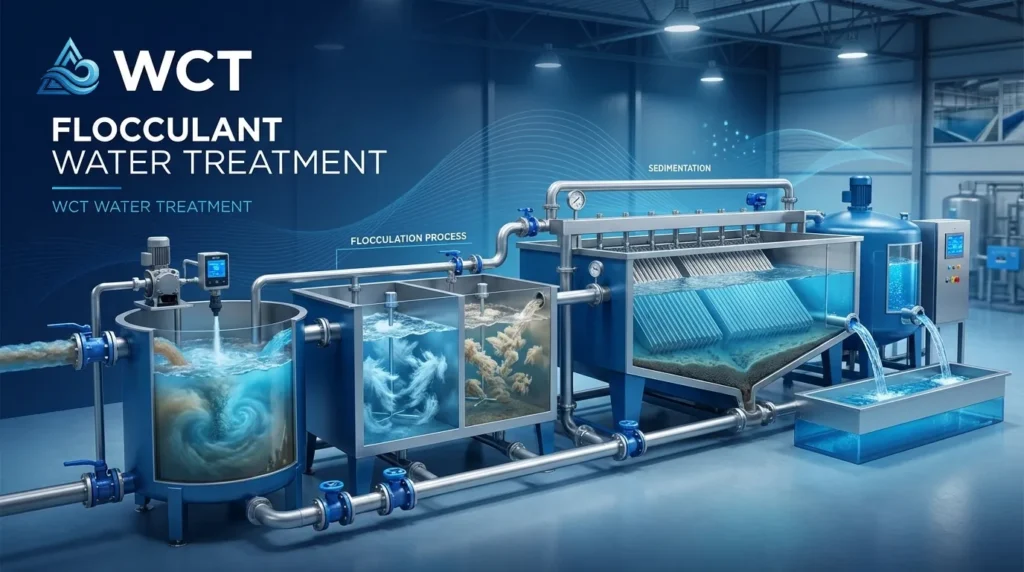
Coagulation vs. Flocculation: Understanding the Distinction
Many industrial operators we work with struggle with high operational costs, equipment corrosion, and poor settling rates simply because their chemical treatment process is misaligned. If your effluent remains turbid or your sludge isn\’t dewatering properly, the issue often lies in the fundamental difference between coagulation and flocculation. While these terms are often used interchangeably, they represent two distinct chemical phases that require specific dosing strategies to achieve effective flocculant water treatment.
Coagulation (The Destabilizer)
Coagulation is the initial phase of the treatment process. Most suspended solids in wastewater carry a negative electrical charge, which causes them to repel each other and stay suspended indefinitely.
- The Mechanism: We introduce a coagulant—typically a metal salt like Poly Aluminum Chloride (PAC)—to neutralize these negative charges.
- The Result: Once the charge is neutralized, the repulsive forces vanish, allowing particles to collide and form microscopic clusters known as \”pin flocs.\”
- Our Approach: Effective coagulation requires rapid, high-energy mixing. Our engineering teams design systems that ensure immediate dispersion of PAC before the reaction slows down, preventing chemical waste.
Flocculation (The Bridge Builder)
Once coagulation has destabilized the particles, flocculation takes over to build mass. This step is where the specific flocculant used in water treatment becomes critical.
- The Mechanism: We dose long-chain polymers, such as Polyacrylamide (PAM), into the water. These polymers act like a net, physically bridging the gap between the microscopic pin flocs.
- The Result: The polymers bind the small particles together, creating large, heavy aggregates (flocs) that are visible to the naked eye.
- The Benefit: These larger flocs settle rapidly in sedimentation tanks or float easily in Dissolved Air Flotation (DAF) units, significantly improving solid-liquid separation efficiency.
Visualizing the Process
To optimize your system, you must be able to identify these stages visually during jar tests or in your clarifier:
- Raw Water: Cloudy, with suspended particles that do not settle over time.
- Post-Coagulation: Water appears slightly clearer, but particles resemble fine dust (pin flocs).
- Post-Flocculation: Distinct, large clumps form rapidly, leaving clear water between them.
If you do not see large, stable clumps, your flocculant in water treatment dosing ratios or mixing speeds may be incorrect. We design our Automatic Chemical Dosing Systems to precisely manage these variables, ensuring you don\’t waste expensive chemicals on ineffective reactions.
Types of Flocculants Used in Industrial Applications
Selecting the correct chemical agent is the difference between clear effluent and a clogged system. In flocculant water treatment, we categorize these agents based on their chemical composition and charge density. At WCT, our dosing equipment is engineered to handle the specific viscosity and mixing requirements of these distinct categories.
Synthetic Polymers (Polyacrylamide – PAM)
Synthetic polymers are the workhorses of modern wastewater facilities. Polyacrylamide (PAM) is the most widely used flocculant due to its ability to form long chains that trap particles effectively. However, you cannot use a \”one-size-fits-all\” approach; the ionic charge must match your specific waste stream.
- Cationic PAM: Positively charged. These are essential for treating organic sludge, such as municipal sewage or food processing waste, where particles carry a negative charge.
- Anionic PAM: Negatively charged. We typically deploy these for inorganic solids, such as mineral tailings, sand, or metal hydroxides found in industrial mining and metallurgy.
- Non-ionic PAM: Neutral charge. These are used in complex environments where pH levels fluctuate significantly or where mixed effluents require a balanced approach.
Natural and Mineral Alternatives
While synthetic polymers dominate due to efficiency, some specific applications require alternative solutions.
- Natural and Bio-Flocculants: Options like Chitosan and starch-based derivatives are gaining traction for operations prioritizing eco-friendly or food-grade certifications. They are biodegradable but often require higher dosage rates compared to PAM.
- Mineral Flocculants: Agents like activated silica and colloidal clays are often used as coagulant aids to weigh down light flocs, improving settling speeds in sedimentation tanks.
For more detailed engineering guides on chemical properties and selection, you can explore our industry knowledge resources.
The Critical Role of Automated Dosing Systems in Flocculant Water Treatment
When managing a flocculant water treatment process, how you add the chemicals is just as critical as the chemicals themselves. Relying on manual labor for this step is a fast track to operational inefficiency.
Why Manual Dosing Fails
- Human Error: Guesswork leads to incorrect dosages, which severely limits your solid-liquid separation efficiency.
- Chemical Waste: Over-dosing wastes expensive polymers and unnecessarily drives up your daily operating costs.
- Inconsistent Flocs: Uneven chemical distribution creates fragile, inconsistent flocs that fail to settle properly in the tank.
WCT Automated Powder/Liquid Dosing Systems
To eliminate these process bottlenecks, we designed an automated chemical dosing system tailored to the exact demands of modern facilities. Our polymer preparation unit flawlessly manages the complete preparation and aging workflows. Whether you are applying a dry powder or liquid water treatment flocculant, our advanced chemical dosing equipment for municipal water treatment ensures the solution is mixed to the precise concentration and aged for the optimal time before injection.
Precision Metering and Unyielding Materials
Injecting a flocculant in water treatment requires absolute precision to keep the effluent clear. We achieve this strict control by utilizing our AXB Series mechanical diaphragm metering pumps for highly accurate Polyacrylamide (PAM) dosing.
Equipment Advantages at a Glance:
- Pinpoint Accuracy: The mechanical diaphragm design delivers precise, repeatable flow rates to optimize the floc formation rate.
- Maximum Durability: We construct these systems with PE304 Stainless Steel. This provides outstanding corrosion resistance against aggressive industrial effluent and raw chemical agents.
By fully automating the dosage of the flocculant used in water treatment, we remove the guesswork, slash chemical waste, and guarantee a stable, continuous treatment cycle.
Integrating Flocculants with Solid-Liquid Separation Equipment
Once the flocculant water treatment process creates large particle clumps, we must physically remove them. The secret to maximizing solid-liquid separation efficiency is directly pairing your chemical dosing with the right mechanical setup.
Sedimentation Tank Optimization
- Accelerated Settling: In standard gravity clarifiers, effective flocculants make particles heavy and dense enough to drop out of suspension rapidly.
- Clearer Effluent: These heavy flocs sink efficiently to the bottom, leaving highly purified, clear water at the top of the tank.
Dissolved Air Flotation (DAF)
- Floating Light Flocs: Not all treated particles sink. For lighter flocs, we introduce tiny air bubbles that attach to the solid masses and lift them.
- Surface Skimming: Integrating a reliable Dissolved Air Flotation (DAF) system makes it easy to skim off oils, fats, and low-density suspended solids from the water\’s surface.
Sludge Dewatering Equipment
- Moisture Release: The wet sludge collected from clarifiers or DAF units still holds a massive amount of water. Using a targeted flocculant in water treatment prepares this sludge to release its bound moisture.
- Mechanical Pressing: Heavy-duty sludge dewatering equipment, such as multi-disk screw presses or belt presses, forcefully squeezes out the remaining water. This creates a dry sludge cake, drastically shrinking your final waste volume and cutting hauling costs.
Key Industries for Flocculant Water Treatment
We see flocculant water treatment applied across diverse global sectors to meet strict environmental and operational demands. Implementing the right flocculant for water treatment ensures high solid-liquid separation efficiency. Whether upgrading an independent facility or integrating automated dosing systems into large-scale plants for water treatment, matching the chemical to the industry is critical.
Industrial Effluent Treatment
- Automotive & Electronics: We rely on targeted polymers to achieve zero liquid discharge (ZLD) in heavy manufacturing.
- Wastewater Turbidity Reduction: Flocculants in water treatment bind fine particulates and heavy metals, allowing factories to safely recycle and reuse process water.
Oil & Gas Water Recovery
- Produced Water: Injecting a robust water treatment flocculant quickly breaks stubborn oil-water emulsions.
- Fracking Fluids: Effectively removes massive volumes of suspended solids (TSS) and drilling contaminants from the production water cycle.
Municipal Wastewater Solutions
- Phosphorus Removal: A specialized flocculant used in water treatment helps precipitate and capture excess nutrients before environmental discharge.
- Sludge Thickening: Prepares municipal waste for downstream sludge dewatering equipment, drastically cutting disposal volume and improving overall sedimentation tank optimization.
Troubleshooting Flocculant Water Treatment Failures
Even with high-quality chemicals, the flocculant water treatment process can occasionally fail. When your solid-liquid separation efficiency drops, the root cause usually comes down to mixing, acidity, or temperature. Here is how we troubleshoot the most common issues:
- Shear Sensitivity (Mixer Speeds): Flocs are delicate structures. If you run your mixers too fast, the high shear forces will literally tear the formed clumps apart. To protect the flocculant used in water treatment, use rapid mixing only for the initial dispersion. Once the chemical is in the water, immediately lower the RPM to gently build the flocs without breaking them.
- pH Dependency: Every water treatment flocculant has a specific pH sweet spot. If your wastewater is too acidic or alkaline, the polymer chains cannot uncoil and bind to the suspended solids. Always test and adjust the water\’s pH before dosing to ensure maximum polymer effectiveness.
- Temperature Effects: Cold water drastically slows down chemical reactions and reduces your overall floc formation rate. In cold conditions—such as outdoor cooling tower water treatment systems—you must increase your mixing time and retention time. This compensates for the sluggish reaction and gives the flocculant in water treatment enough time to capture the particles.
Frequently Asked Questions About Flocculant Water Treatment
-
What is the main difference between a coagulant and a flocculant?
In the coagulation and flocculation process, coagulants (like PAC injection) neutralize the electrical charges on colloidal particles so they stop repelling each other. A water treatment flocculant then steps in to act like a sticky net, chaining these neutralized particles into large, heavy masses that settle out of the water quickly. -
How do I determine the optimal dosage for my wastewater?
We always rely on jar testing. By testing small samples with a specific flocculant used in water treatment, you can visually monitor the floc formation rate and accurately measure your wastewater turbidity reduction. Once you find the sweet spot, an automated chemical dosing system will ensure you consistently hit that exact dosage at scale. -
Can I mix different types of flocculants together?
Never mix them directly in the same tank. This is critical when selecting a flocculant for water treatment that involves conflicting charges, such as anionic vs cationic polymers. Mixing them creates a thick, unusable gel that ruins the batch. If your suspended solids (TSS) treatment requires multiple chemical layers, you must dose them separately into the pipeline with enough physical space for mixing in between. -
Why is my flocculant system clogging frequently?
Managing a flocculant in water treatment requires keeping dry powders away from moisture until mixing. Clogging is almost always caused by insufficient mixing in the polymer preparation unit, which allows undissolved gel lumps (often called \”fisheyes\”) to form. Ensure you give the polymer proper aging time to fully activate. To protect your equipment from jamming, we recommend installing a reliable precision filter for water treatment just before your dosing pumps to catch any stubborn gel particles before they block the lines.