You might already know that failing to meet IMO D-2 and USCG regulations can ground your fleet and cost millions.
But how do you actually choose the right technology when every vessel has a different footprint, OPEX budget, and operational route?
As experts in marine engineering, we know that investing in a reliable ballast water treatment system goes beyond basic compliance—it’s a critical decision that impacts your fleet\’s long-term efficiency and structural integrity.
In this guide, you\’re going to learn exactly how to navigate the complex global regulatory landscape, compare core technologies like UV and electro-chlorination, and select the perfect modular setup for your exact vessel.
If you are looking to secure foolproof compliance and optimize your maritime operations, this guide is for you.
Let\’s dive right in.
The Environmental and Economic Impact of Untreated Ballast Water
Why does the maritime industry care so much about what sits in our ballast tanks? When a vessel takes on water in one port and discharges it in another without passing through a reliable ballast water treatment system, it transports a hidden, destructive cargo.
The Biological Threat: Pathogens and Invasive Species
Untreated ballast water is a primary vector for severe ecological disruption. Every day, ships transfer millions of microscopic organisms across global waters.
- Invasive Species: Organisms like zebra mussels and toxic algae outcompete native aquatic life, permanently destroying local food webs. Effective marine invasive species prevention is a critical operational necessity.
- Pathogens and Microbes: Unregulated discharge can introduce dangerous bacteria and viruses into new environments, threatening both marine ecosystems and public health.
Economic Consequences for Coastal Industries
The fallout extends far beyond environmental damage—it directly hits regional bottom lines.
- Commercial Fishing: Invasive marine predators decimate native fish stocks, wiping out local fishery revenues.
- Tourism: Toxic algae blooms ruin beaches and coastal recreational zones, causing massive economic losses for coastal communities.
- Infrastructure Damage: Unchecked biofouling clogs water intake pipes for power plants, desalination facilities, and municipal water systems, leading to steep repair and OPEX costs.
The Global Initiative to Halt Cross-Contamination
The international community has drawn a hard line. Driven by the Ballast water management convention, maritime authorities are enforcing strict regulations to stop aquatic cross-contamination. As a dedicated manufacturer, we recognize that engineering and integrating a compliant water ballast treatment system is the only sustainable path forward for modern fleets. Implementing rigorous ballast water treatment through a certified ballast water treatment system for ship operations is now the baseline global standard to protect our oceans and international economies.
Navigating the Regulatory Landscape for BWTS
As a leading manufacturer, we know that installing a compliant ballast water treatment system for ship operations is mandatory, not optional. Maritime environmental regulations are strict, and your fleet must meet two primary global standards to operate legally.
IMO Ballast Water Management Convention
The BWM convention outlines the global rules required to stop marine invasive species.
- D-1 Standard: Focuses on manual ballast water exchange in open seas. This method is actively being phased out globally.
- D-2 Standard: Sets strict, measurable limits on the number of viable organisms allowed in discharged water. Meeting this requires an active, onboard water ballast treatment system.
- The Deadline: All commercial ships must achieve full IMO D-2 standard compliance by September 8, 2026.
USCG Regulations and Type Approval
If your vessel operates in United States waters, IMO certification alone is not enough. You must secure USCG type approval.
- Testing Protocol Differences: The US Coast Guard uses significantly stricter testing protocols. While the IMO standard often accepts organisms that are rendered \”non-viable\” (unable to reproduce), the USCG strictly measures \”living\” versus \”dead\” organisms.
- Technology Compliance: Whether your ship relies on electro-chlorination or a heavy-duty ultraviolet water treatment system, the core technology must pass these rigorous US tests to legally discharge water.
We design every ballast water treatment system to guarantee dual compliance with both IMO and USCG standards, ensuring your vessel avoids hefty regulatory fines, port detentions, and operational delays.
How Does a Ballast Water Treatment System Work?
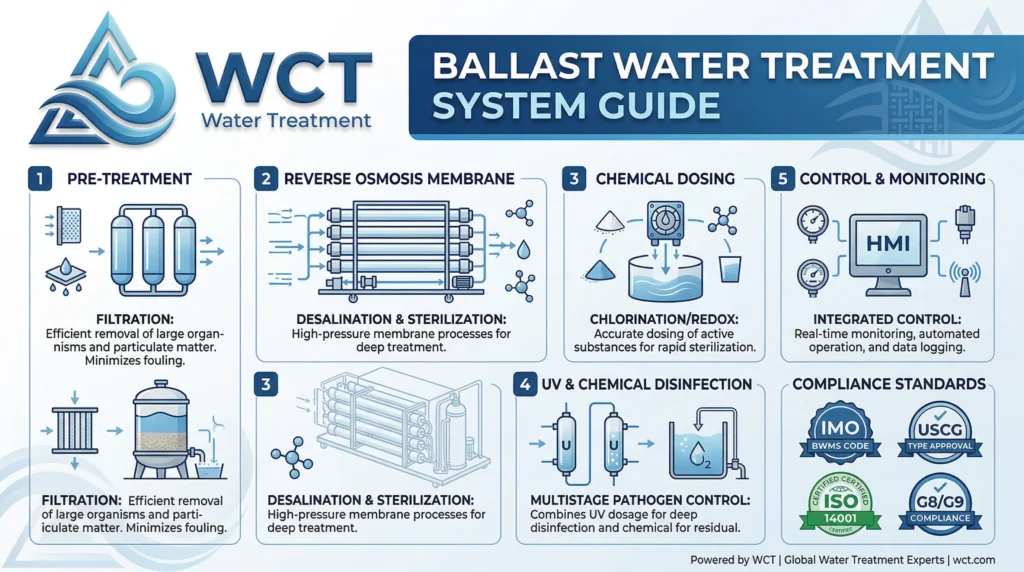
As a trusted manufacturer, we design our ballast water treatment system units to be efficient, reliable, and straightforward. Preventing marine invasive species requires a precise, two-step approach before the water is ever discharged. Here is exactly how our systems process the intake water.
Stage 1: Mechanical Separation
The first line of defense in a ballast water filtration system is physical separation. Before any disinfection happens, we must remove the bulk of the physical contaminants.
- Large Organism Removal: We push the intake water through robust screens and specialized water treatment filter media to trap zooplankton, large debris, and marine life.
- Sediment Control: Filtering out solid sediments early significantly reduces mud buildup, minimizing the need for frequent ship ballast tank maintenance.
- Efficiency Boost: Clearing the water of physical particles ensures the biological treatment phase can operate at peak performance without turbidity interference.
Stage 2: Biological Treatment
Once the water is filtered, it moves directly into the disinfection phase. This stage neutralizes microscopic organisms, bacteria, and viruses to guarantee strict IMO D-2 standard compliance.
- Targeted Disinfection: We apply powerful treatments to neutralize unseen biological threats at the cellular level, ensuring nothing survives the journey.
- UV Disinfection: A highly effective method involves running the filtered water through a commercial UV water treatment system. This UV disinfection ballast water technology destroys the DNA of microbes instantly without adding harmful chemicals to the tank.
- Active Substances: For larger vessels, electro-chlorination water treatment is often utilized to generate hypochlorite, effectively sterilizing the remaining water through controlled oxidation.
By seamlessly combining these two stages, a modern water ballast treatment system guarantees that the water released back into the ocean is safe, clean, and fully compliant with global maritime environmental regulations.
Core Technologies in a Modern Ballast Water Treatment System
As a dedicated water treatment products supplier and manufacturer, we know that no single technology fits every fleet. The right ballast water treatment system for your ship depends heavily on operational routes, vessel ballast capacity, and local water conditions. Here is a straightforward breakdown of the core technologies powering today\’s compliant systems.
UV (Ultraviolet) Irradiation
This method relies on high-intensity UV lamps to alter the DNA of marine microbes, neutralizing their ability to reproduce.
- Pros: It is 100% chemical-free, safe for crew handling, and leaves no residual byproducts.
- Cons: Its efficiency drops in highly turbid or muddy coastal waters where light struggles to penetrate.
For vessels operating in standard conditions, implementing reliable UV light water treatment is one of the most efficient ways to achieve strict UV disinfection ballast water compliance.
Electro-Chlorination (Electrolysis)
This electro-chlorination water treatment process passes an electrical current directly through natural seawater. This creates sodium hypochlorite (active chlorine), which disinfects the incoming water.
- Pros: Highly effective for large-capacity vessels and easily handles extremely muddy or murky waters.
- Cons: It requires salt to function. If your ship regularly takes on fresh water, you will need to install a supplementary brine or salt tank onboard.
Chemical Injection (Biocides)
Rather than generating a disinfectant onboard, this method utilizes an automated ballast water chemical dosing system to inject liquid biocides directly into the ballast lines during uptake.
- Pros: Requires very little installation space, making it a great compact option with low power consumption.
- Cons: You must store consumable chemicals onboard and actively neutralize the treated water before discharging it back into the ocean.
Alternative Treatment Methods
While UV and electrolysis dominate the global shipping market, we also integrate specialized methods to support unique ship ballast tank maintenance requirements:
- Ozonation: Pumps ozone gas directly into the water to rapidly break down and destroy organic matter.
- Deoxygenation: Strips the oxygen out of the ballast tanks. This suffocates marine organisms while simultaneously preventing internal tank corrosion.
- Ultrasonic Treatments: Blasts high-frequency sound waves to physically rupture the cell walls of microscopic organisms, often paired with UV systems as a pre-treatment booster.
5 Key Factors When Choosing a Ballast Water Treatment System
Selecting the right equipment for your vessel shouldn\’t be a guessing game. As an experienced water treatment products supplier and manufacturer, we know exactly what you need to evaluate before making a purchase. Here are the five critical factors to consider to keep your ship compliant and efficient:
- Regulatory Certifications: Compliance is non-negotiable. Always verify that your equipment has both IMO D-2 standard compliance and full USCG type approval. This dual certification guarantees you meet strict maritime environmental regulations globally.
- Vessel Footprint & Modularity: Engine room space is always tight. You need a compact ballast treatment system. Look for skid-mounted or modular designs that make BWTS installation and retrofitting straightforward without requiring massive structural changes to your ship.
- CAPEX vs. OPEX: Balancing your budget means looking past the initial price tag. Weigh your capital expenditure (purchase cost) against ongoing operational expenses. Factor in power consumption, maintenance requirements, and the system\’s expected lifespan to find true long-term value.
- Operational Limitations: Your ship\’s specific route matters. Evaluate the water types, salinity levels, and turbidity your vessel regularly encounters. Different technologies respond differently to poor water quality. Whether your setup requires UV filtration or a highly automated chemical dosing system, ensure the technology matches your operational profile and water conditions.
- Reliability & Material Durability: The marine environment is unforgiving. Your ballast water treatment system must be built tough. Insist on marine-grade, corrosion-resistant materials and robust components to prevent unexpected breakdowns and costly downtime at port.
FAQs About Ballast Water Treatment Systems
IMO vs USCG Type Approval
The core difference lies in their testing protocols. The global BWM convention (focusing on IMO D-2 standard compliance) considers organisms harmless if they are rendered non-viable and cannot reproduce. In contrast, USCG type approval is stricter, demanding that all organisms be visibly dead. We always advise securing a system with dual approval if your fleet operates in United States waters.
Cost of BWTS Installation and Retrofitting
Pricing depends heavily on your vessel ballast capacity and the chosen technology. As a manufacturer, we see typical ballast water treatment system equipment and installation costs ranging from $150,000 to over $800,000. BWTS installation and retrofitting on older ships generally hit the higher end of that scale due to complex 3D scanning, tight space constraints, and custom pipe routing.
Best Technology for Your Vessel
There is no one-size-fits-all approach to marine invasive species prevention. We recommend selecting based on your ship\’s profile:
- UV Disinfection: Perfect for compact spaces, container ships, and vessels operating mainly in clear waters.
- Electro-chlorination: The heavy-duty choice for large bulkers and oil tankers handling massive flow rates. Keep in mind, supporting these large-scale systems and keeping pipelines clear often requires reliable water treatment chemicals to manage scaling and ensure smooth, automated chemical dosing.
Expected Operational Lifespan
When built with robust marine-grade materials, a modern water ballast treatment system is designed to last the lifetime of your vessel. With proper ship ballast tank maintenance, filter cleaning, and routine sensor calibration, you can expect a solid 15 to 25 years of reliable, compliant service.